
Home Care Agency Insurance: Which Policies You Need
Home care agencies need general and professional liability, workers' comp, non-owned auto, a fidelity bond and cyber cover. What states require, with minimums.
By Caregiver Scheduling Team ·
A non-medical home care agency needs six policies: general liability, professional liability, workers’ compensation, non-owned and hired auto, an employee dishonesty (fidelity) bond, and cyber liability. Abuse and molestation and employment practices coverage are common add-ons. Several states set minimums in their licensing rules. Washington requires $1 million per occurrence in general liability before it will issue a license (WAC 246-335-320).
Which policies does a home care agency need?
Each policy covers a different way an agency gets sued or loses money.
| Policy | Covers | Usually required by |
|---|---|---|
| General liability | Injury or property damage in clients’ homes | Licensing, referral contracts |
| Professional liability | Claims that care was negligent | Some states, payer contracts |
| Workers’ compensation | Caregiver injuries on the job | State law once you have employees |
| Non-owned and hired auto | Accidents while caregivers drive their own cars for work | Contracts, prudence |
| Fidelity or employee dishonesty bond | Theft from clients by employees | Many states, clients and payers |
| Cyber liability | Breaches, ransomware, notification costs | Prudence, especially if HIPAA applies |
| Abuse and molestation | Abuse allegations, often excluded from general liability | Prudence, some contracts |
| Employment practices liability | Wage, discrimination and wrongful termination claims | Prudence |
| Surety bond | Agency obligations to a state or payer | Some states and payers. See surety bonds |
What do states actually require?
It varies. Three states show the range.
| State | Rule | Minimum |
|---|---|---|
| Washington | WAC 246-335-320 | General liability of $1 million per occurrence, or $2 million combined single limit, submitted with the license application |
| Virginia | 12VAC5-381-210 | $1 million comprehensive general liability per occurrence, malpractice insurance, and third-party crime insurance or a $50,000 blanket fidelity bond |
| Florida | Fla. Stat. 400.471(3) | Malpractice and liability insurance of at least $250,000 per claim for home health agencies |
Referral sources and payers often ask for more than the state minimum, commonly $1 million per occurrence and $2 million or $3 million aggregate. Read the insurance clause before you sign. Check your state in our licensing tool.
Is workers’ comp required for caregivers?
In nearly every state, yes, once you have employees. Workers’ compensation is run by each state, and the U.S. Department of Labor directs private employers to their state board (DOL). Texas is the main exception: the Texas Department of Insurance says private employers “can choose to carry” coverage and that it is “not required in most cases” (TDI). Most Texas agencies carry it anyway, because non-subscribers lose common-law defenses when a caregiver sues.
Transfers, lifting and falls drive most caregiver claims. Workers’ comp is priced per $100 of payroll, so it is often the largest insurance line. Put it in your payroll burden when you set rates.
Do you need auto coverage if caregivers drive their own cars?
Yes. If a caregiver causes an accident while driving a client or traveling between visits, the agency can be sued as the employer, and the caregiver’s personal policy may deny the claim as business use. Non-owned and hired auto coverage protects the agency, not the caregiver’s car. Pair it with a driving policy: proof of personal insurance, a yearly motor vehicle record check, and a rule on who may transport clients. See caregiver mileage reimbursement and travel time pay.
What is the difference between a fidelity bond and a surety bond?
A fidelity bond pays the client when an employee steals from them. A surety bond guarantees the agency’s own obligations to a state or payer, such as repaying Medicaid overpayments. When families ask whether caregivers are “bonded,” they mean fidelity coverage. Virginia requires at least $50,000 of it as a licensing condition. Surety bond rules are state-specific; see our surety bond directory.
Do you need cyber liability insurance?
If you keep client records electronically, yes. A breach of unsecured health information triggers notice to every affected person “without unreasonable delay and in no case later than 60 calendar days” after discovery (45 CFR 164.404). Letters, credit monitoring, forensics and legal review cost money even when no one is harmed. Cyber policies cover those costs and ransomware. See our HIPAA checklist.
What drives the premium, and how do you lower it?
Premiums follow services, payroll, driving and claims history. Personal care with transfers costs more to insure than companion care. Workers’ comp and employment practices premiums scale with headcount. Transporting clients raises auto cost. Three years of losses set your rate.
To bring it down: train caregivers on safe transfers, check driving records, report injuries the same day, document every visit, and use a broker who writes home care agencies every week.
How Caregiver Scheduling handles this
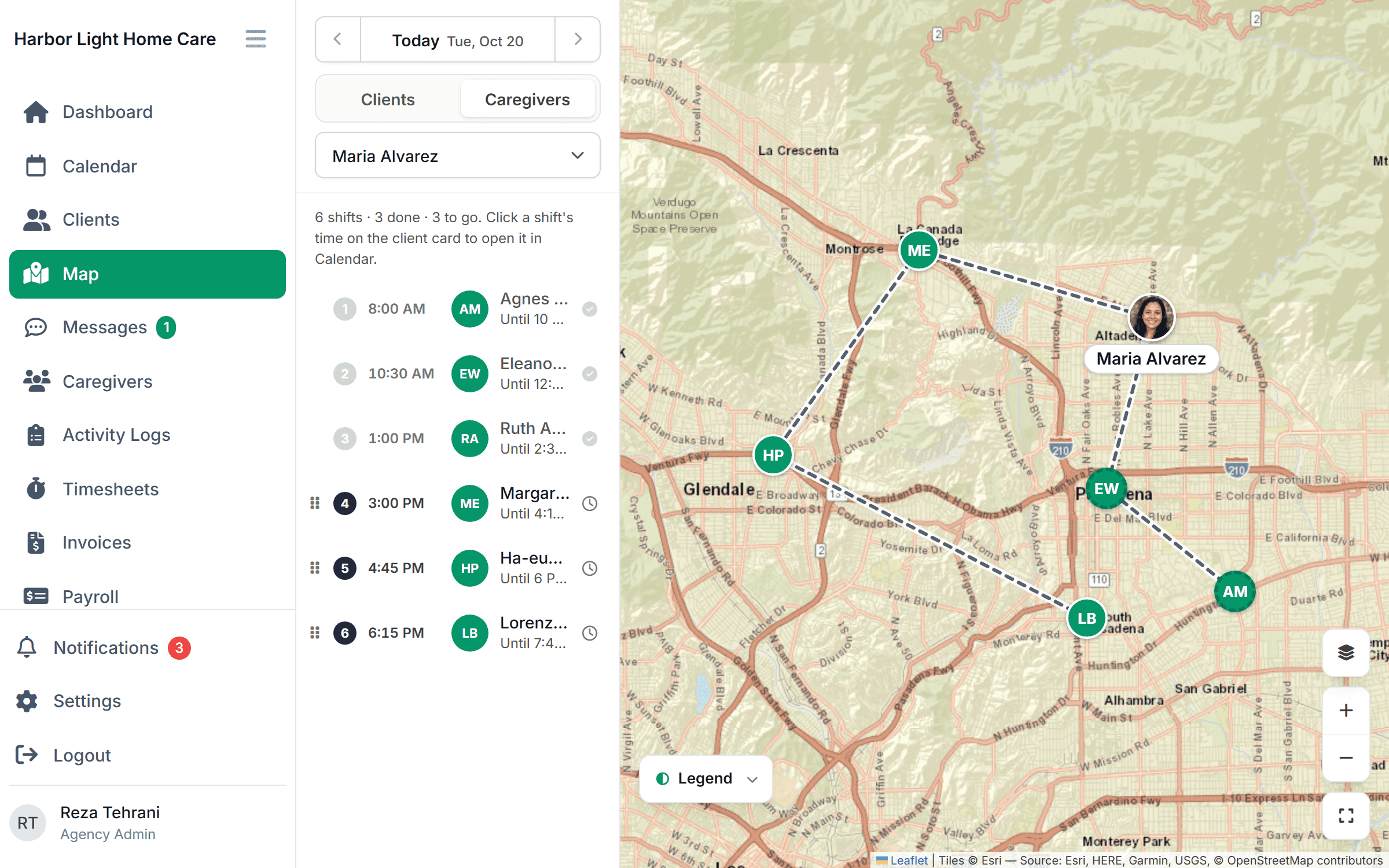
Insurance pays after something goes wrong; records decide whether a claim sticks. Caregiver Scheduling gives you geofenced GPS check-in and check-out for every visit, task checklists, visit notes, and credential tracking for background checks and driving records. When a carrier asks who was in the home and what was done, the answer is a verified record. $199/month for up to 10 caregivers or $299/month for up to 50, free for 30 days.
FAQ
Is workers’ comp required for caregivers? In nearly every state once you have employees. Texas lets private employers opt out, but most agencies carry it anyway.
Does my personal auto policy cover caregivers? No. Caregivers’ own policies may exclude business use. Non-owned and hired auto protects the agency.
Are caregivers “bonded” if I have general liability? No. Bonding means a fidelity or employee dishonesty bond covering theft from clients. It is a separate policy.
What limits should a new agency buy? What your state and your first referral contracts require. $1 million per occurrence general liability is the most common ask.
This article is general information, not legal or insurance advice. Check your state’s licensing rules and your contracts.